Executive software purchase brief template
The decision and commitment come first. A sponsor needs to understand what saying yes authorizes. The cost weakness and unresolved access failure stay on page one; the test log belongs in the appendix.
Download Word · 2 pages ↓No email required. Includes a clearly labeled fictional example.
The order of the conversation
- Decision requested and scope
- Business reason and cost
- Material risk and uncertainty
- Conditions and next review
A finished example
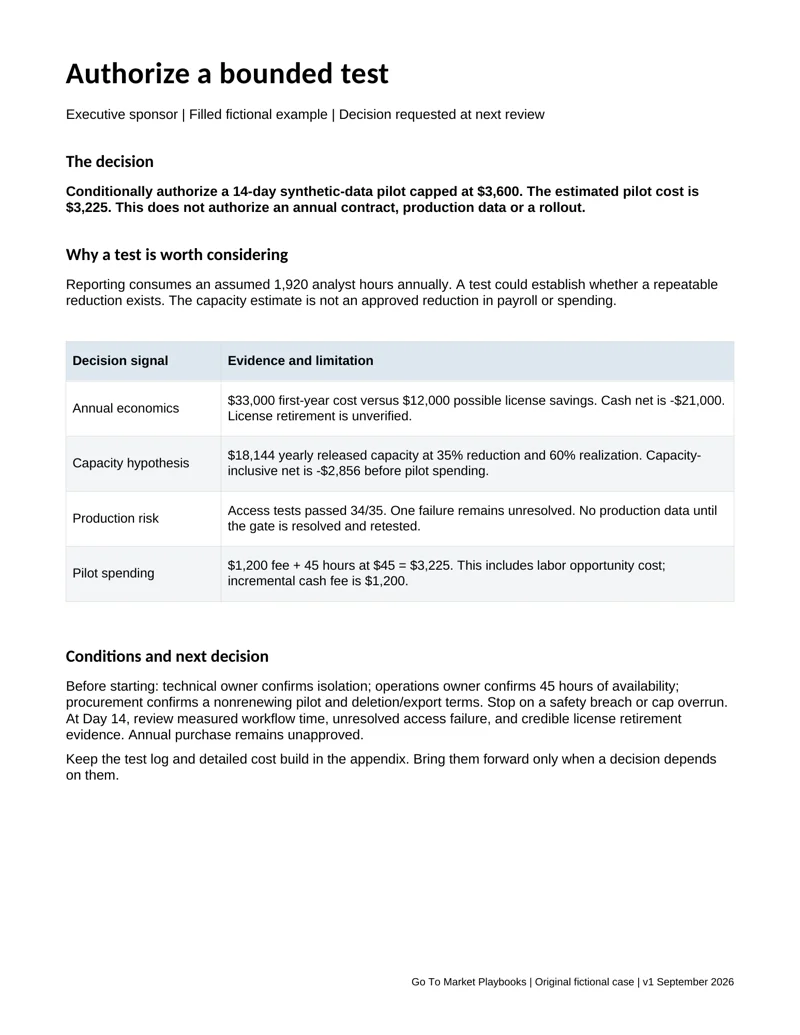
$3,600 cap · $3,225 estimated pilot cost Conditional synthetic-data pilot. Annual purchase remains unapproved.
- Annual economics
- $33,000 cost versus $12,000 possible license savings; cash net −$21,000. Retirement unverified.
- Capacity hypothesis
- $18,144 estimated yearly capacity value; capacity-inclusive net −$2,856 before pilot spending.
- Production risk
- Access tests passed 34/35. One failure remains unresolved. No production data.
Before the sponsor meeting
Write the authorization in one sentence: what can start, what cannot, and who owns the decision. Put the commitment and the strongest reason to pause above the activity history. A bounded pilot and an annual agreement are different decisions.
What earns a place on page one
Include a cost ceiling, the unresolved issue that could change the answer, and the next evidence review. Keep the test log available as supporting detail. If the reader has to infer whether production access is allowed, the brief is incomplete.
Sponsor review checklist
Can the sponsor repeat the requested commitment? Is the risk visible beside the benefit? Are conditions owned and dated? Record the actual decision after the meeting; a draft recommendation is not authorization.
A common formatting mistake
An activity recap that asks the sponsor to infer the decision. The layout keeps the meeting decision, evidence boundary and next action together so uncertainty survives the presentation.
Adapt the same evidence for another audience
Use the local presentation builder to reorder approved information without retyping it, or compare all five files in the buying decision kit. Coordinate evidence owners using the mutual action plan.
Original educational layouts. All example observations are invented, not benchmarks or customer proof.