Show each audience the evidence they need, in the order they need it. Finished examples, editable layouts and a transparent finance model—plus the reasoning behind each presentation choice.
Four Word audience files + Excel model + Word presenter guide. No email required.
THE SHARED CASE
The numbers don’t justify an annual commitment yet.
A fictional team is evaluating a reporting workflow product. Potential license savings are unverified, capacity release is uncertain, and one access-control test failed. The request is a conditional, isolated synthetic-data pilot. Every number and observation is invented; these are original editorial examples, not benchmarks or customer proof.
$33,000First-year production cost
−$21,000Illustrative year-one cash net
1 failed testProduction access remains blocked
See the common assumptions and boundaries
10 analysts × 4 hours/week × 48 weeks × $45/hour = $86,400 baseline capacity cost. A 35% reduction at 60% realization yields $18,144 estimated capacity value. Possible legacy license retirement: $12,000/year, unverified. Production: $18,000 annual subscription + $6,000 implementation + $9,000 incremental rollout support cash spend. Pilot: $1,200 fee + 45 hours × $45 = $3,225 economic cost; incremental cash fee is $1,200. The $3,600 cap includes labor opportunity cost.
Annual figures exclude pilot spending. Combined first-year cost is $36,225; capacity-inclusive net becomes −$6,081. This is a simple full-year model, without discounting, taxes or adoption timing. Isolation, role availability and nonrenewing exit terms are open prerequisites. No annual purchase or production use is authorized.
CHANGE THE AUDIENCE
The facts stay. The hierarchy changes.
Choose a persona to compare the headline, information order, visual layout and evidence emphasis.
Executive sponsor
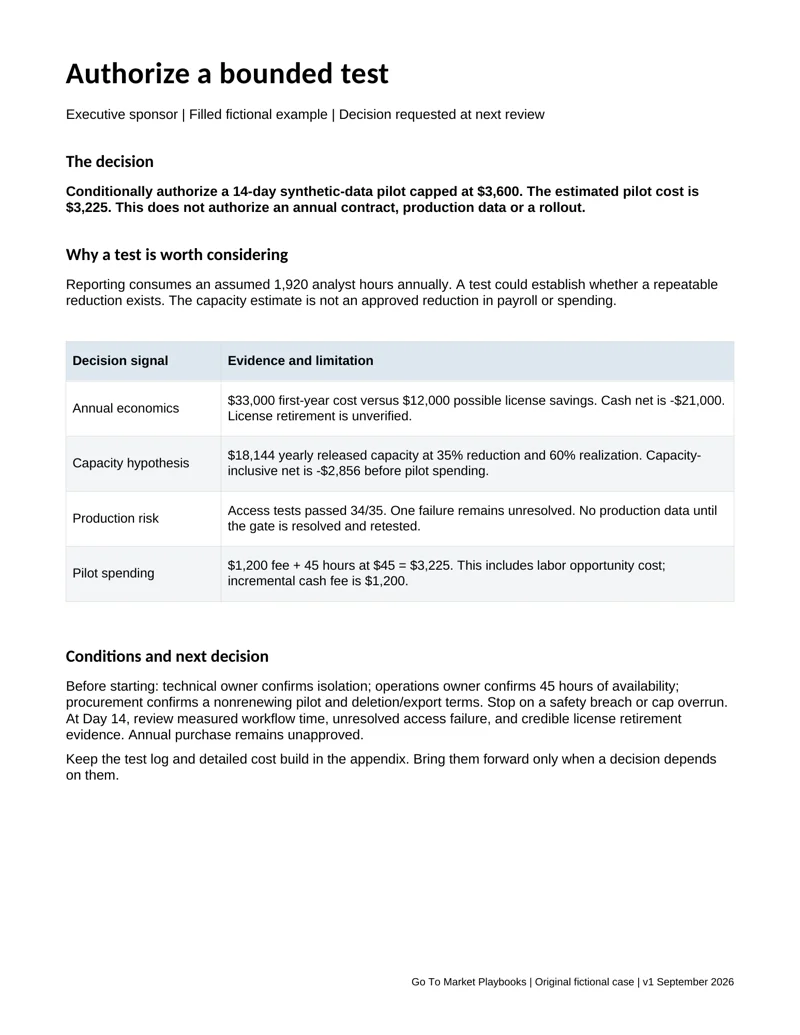
Authorize a bounded test
The decision and commitment come first.
Information order
Decision requested and scope
Business reason and cost
Material risk and uncertainty
Conditions and next review
Why this layout
A sponsor needs to understand what saying yes authorizes. The cost weakness and unresolved access failure stay on page one; the test log belongs in the appendix.
Common mistake: An activity recap that asks the sponsor to infer the decision.
$33,000 cost versus $12,000 possible license savings; cash net −$21,000. Retirement unverified.
Capacity hypothesis
$18,144 estimated yearly capacity value; capacity-inclusive net −$2,856 before pilot spending.
Production risk
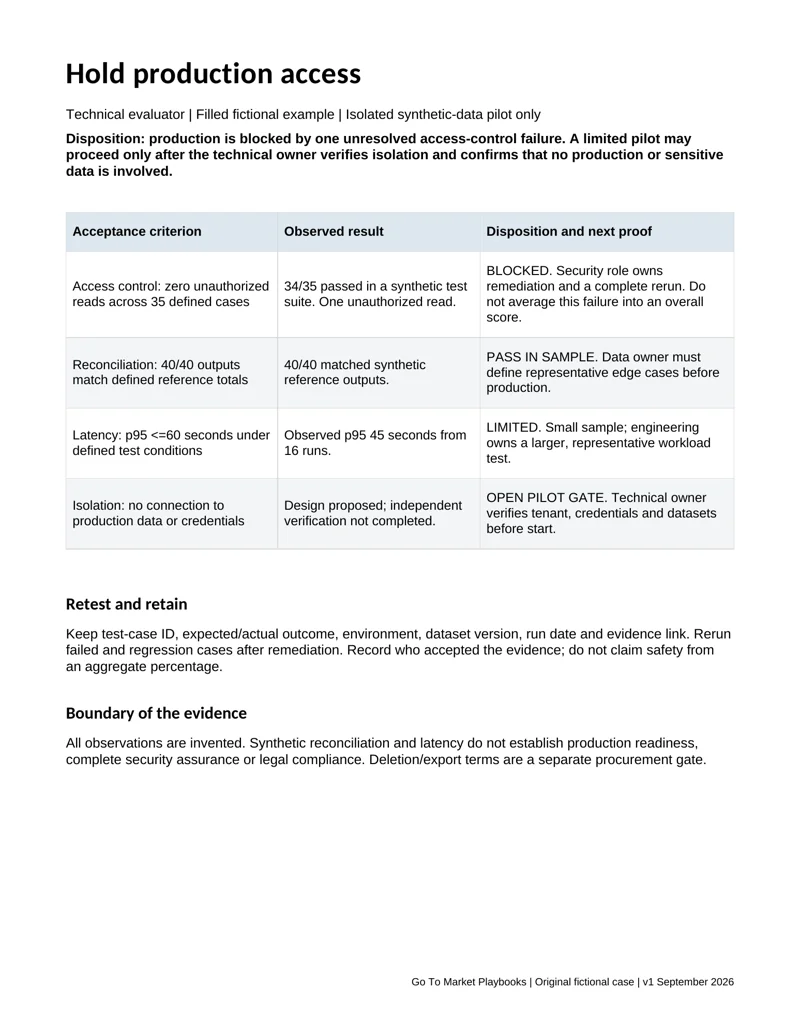
Access tests passed 34/35. One failure remains unresolved. No production data.
Finance
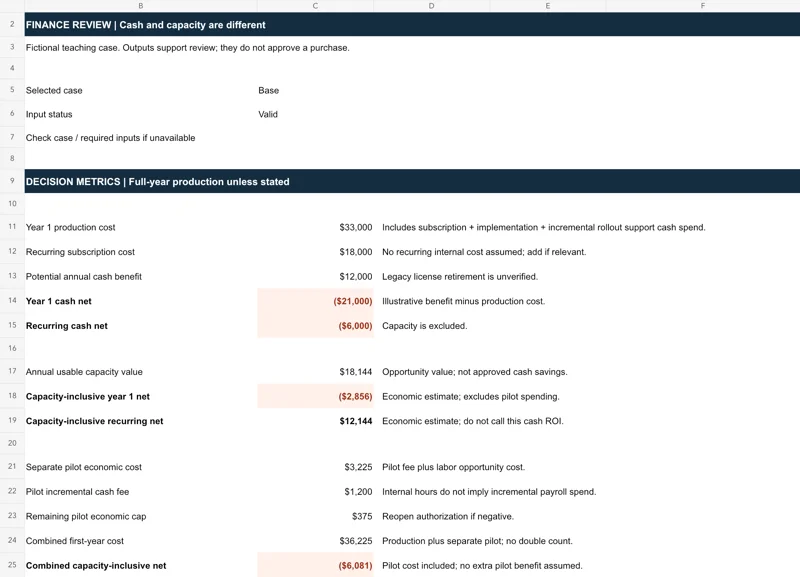
Separate cash from capacity
Total cost comes before estimated value.
Information order
Case selector and input validity
Production cost and potential cash benefit
Capacity value shown separately
Pilot spending and combined first-year cost
Why this layout
The model makes a weak cash case visible even when a capacity estimate sounds attractive. One scenario selector drives one calculation build; missing inputs produce unavailable results.
Common mistake: Calling labor time savings cash ROI, or silently excluding the pilot.
Word · 2 pages · Filled example + editable version
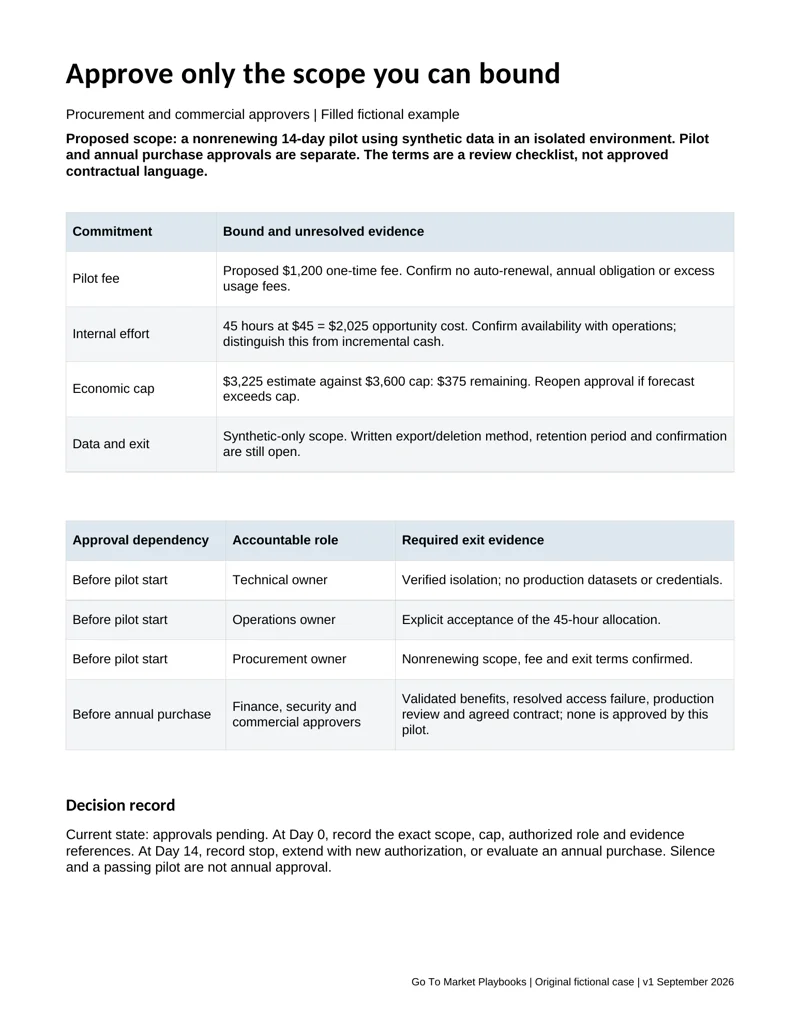
FILLED FICTIONAL EXAMPLE
14-day nonrenewing pilot · terms pending
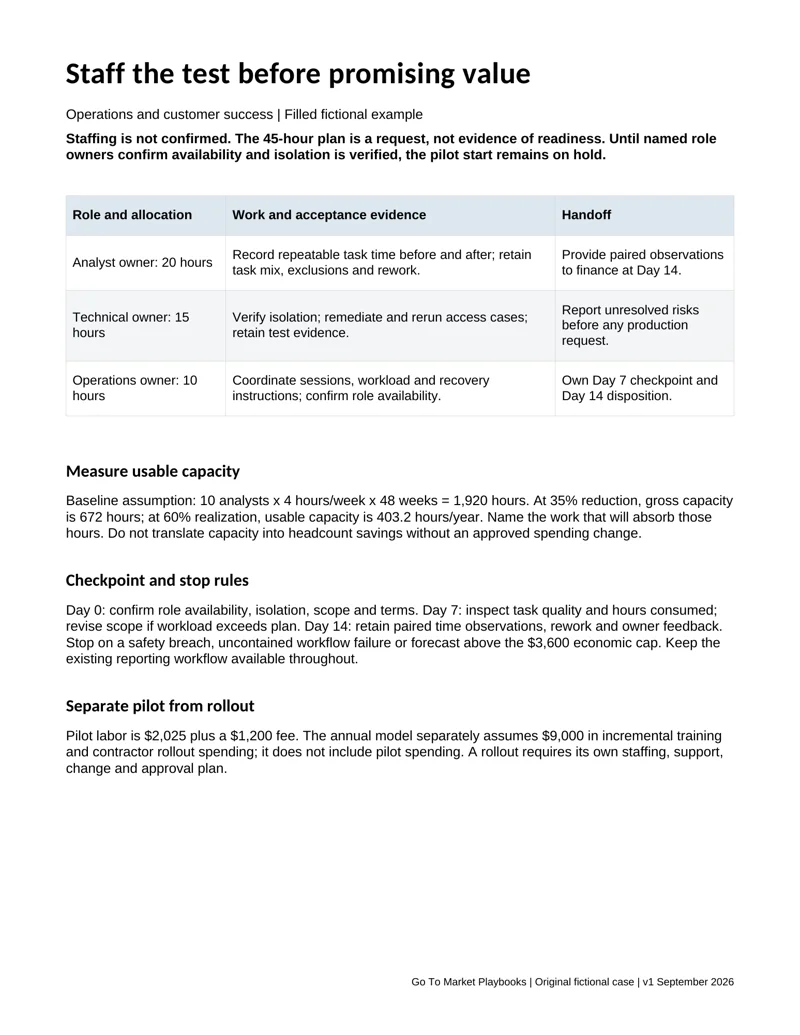
Pilot authorization and annual commitment are separate approvals.
Read the key evidence in text
Fee and effort
$1,200 fee + $2,025 labor opportunity cost. Confirm no auto-renewal or annual obligation.
Economic cap
$3,225 estimate against $3,600 cap; $375 remaining. Reopen if forecast exceeds cap.
Exit evidence
Export/deletion method, retention period and written confirmation remain open.
THE PRESENTATION LOGIC
Know what to move. Know what to keep visible.
The three-page presenter guide explains what belongs first, what can move to an appendix, how to adapt the shared case, and how to check that numbers and risks still agree across audiences. Open the files in Word or Excel; you can also import them into Google Docs or Sheets and review the resulting layout.
Replace fictional observations before sharing your own version. Edit locally using approved information. The site does not receive your file contents.
The mutual action plan coordinates the evidence and approvals behind these presentations. The discovery guide helps establish the baseline. For a cross-functional decision record, use the SaaS decision brief.
Why five files rather than one generic worksheet?
Each file answers a different meeting decision. The executive brief frames a bounded authorization. Finance separates potential cash benefits from estimated capacity. Technical reviewers see critical acceptance failures. Operations sees workload and handoffs. Procurement sees commitments and approval dependencies. You can retain the same evidence without forcing every audience to read the same presentation.
Version 1 · September 2026 · Independent anonymous brand · All examples fictional.