Operations adoption plan template
Workload and handoffs come before the benefit. The plan exposes who must absorb the work. It explains where released hours might go and preserves the existing workflow as a recovery route.
Download Word · 2 pages ↓No email required. Includes a clearly labeled fictional example.
The order of the conversation
- Readiness and scope
- Role hours and completion evidence
- Handoffs and usable capacity
- Checkpoints, stop rules and recovery
A finished example
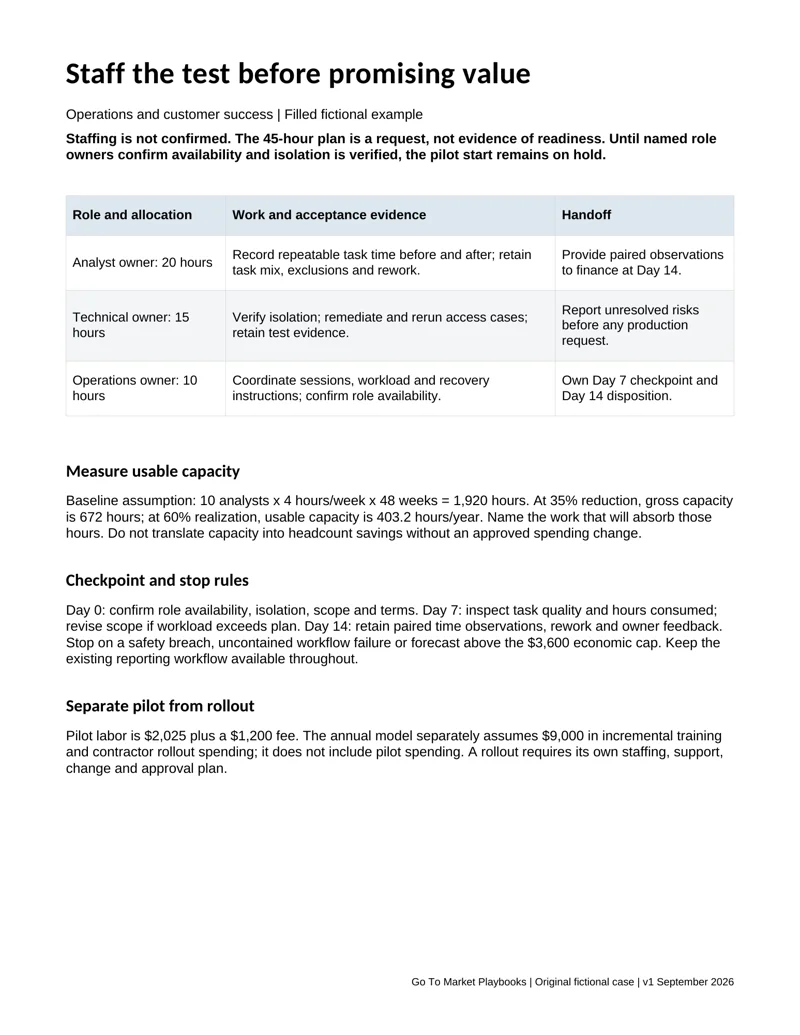
45 internal hours · availability unconfirmed Pilot start remains on hold until role owners accept the work and isolation is verified.
- Analyst owner · 20 hours
- Collect paired task-time observations, task mix, exclusions and rework. Handoff to finance at Day 14.
- Technical owner · 15 hours
- Verify isolation, remediate access failure and retain regression evidence.
- Operations owner · 10 hours
- Coordinate sessions, confirm availability and own Day 7 / Day 14 decisions.
Start with available work capacity
Assign role hours and ask owners to accept them before promising adoption value. A named role without confirmed availability is an open dependency. Keep the current workflow available until recovery and handoff conditions are clear.
Show the handoff, not just the task
For each action, show the artifact, recipient and completion condition. Pair task-time observations with rework and exclusions. Released time is only useful if the team can redeploy it; reduced elapsed time alone does not establish a cash saving.
Operations review checklist
Who absorbs setup and support work? What changes for users? Which checkpoint can pause the rollout? Are recovery actions owned? The template exposes these questions before a launch date is treated as a commitment.
A common formatting mistake
A capacity promise without staffing, rework measurement or ownership. The layout keeps the meeting decision, evidence boundary and next action together so uncertainty survives the presentation.
Adapt the same evidence for another audience
Use the local presentation builder to reorder approved information without retyping it, or compare all five files in the buying decision kit. Coordinate evidence owners using the mutual action plan.
Original educational layouts. All example observations are invented, not benchmarks or customer proof.